Comparing electric van range isn’t as straightforward as it seems. On paper, comparing electric vans looks easy. Manufacturers publish battery capacities. They publish WLTP range. Surely that’s enough to compare vehicles. Unfortunately, it isn’t.
Battery capacity itself is surprisingly inconsistent. Some manufacturers communicate gross battery capacity, others publish only the usable (net) capacity, and the usable share of a battery varies from one model to another. Two vans advertised with similar battery sizes may not actually offer the same usable energy.
That’s why range is often a much more meaningful metric than battery capacity.
Yes, experienced EV users know that real-world driving rarely matches WLTP figures. Weather, payload, driving style and speed all have a significant impact.
But WLTP range has one major advantage: it is standardized. Every manufacturer must follow the same European testing procedure, giving us the closest thing the industry has to an apples-to-apples comparison.
Or at least, that’s the theory.
Even WLTP figures aren’t always directly comparable
In practice, comparing WLTP range across electric vans still contains several pitfalls.
The first is how brands communicate the figure. Many manufacturers publish a single headline range per model — typically the most favourable version — even though the line-up may include multiple body sizes and configurations. The headline tells you what the model can do at its best, not what your specific configuration actually delivers.
The second is body configuration itself. The same model can carry very different certified range depending on wheelbase, roof height or body type, so even per-version figures need to be read alongside the body code they refer to.
The third is speed limitation. The WLTP cycle includes higher-speed phases, so a vehicle restricted to a lower top speed never enters them — and its certified range improves as a result. The clearest illustration sits with N2 electric vans (above 3.5 tonnes GVW), which are legally limited to 90 km/h. On the same battery, they post visibly longer WLTP range than their 3.5-tonne siblings, even though a heavier vehicle should consume more energy. In real fleet operation on identical routes, the gap shrinks substantially.
The same effect appears in lighter vans. The Mercedes eVito, for example, is delivered with an 80 km/h speed limiter in some markets — certified WLTP range improves without any change to the battery or drivetrain.
These distinctions rarely surface in marketing brochures, but they materially shape the numbers a fleet manager reads off the spec sheet.
Making the Comparison as Fair as Possible
At Datatorq, we collect and standardize automotive specifications across 28+ markets. As part of our ongoing series on the European eLCV market, we mapped certified WLTP combined range against net battery capacity for every major electric van segment — small, medium, and heavy.
No comparison can ever be perfect.
But understanding where the differences come from is just as important as knowing the numbers themselves.
Only after accounting for those pitfalls can meaningful benchmarking begin.
So what does the data actually tell us?
Once comparable vehicles are placed side by side, several interesting patterns emerge.
Across all three segments, battery size alone proves to be a surprisingly poor predictor of range.
Efficiency often matters just as much.
Let’s look at each segment.
Combined EV Range Across Small Vans
The small van segment makes the point immediately: battery size and range don’t move in lockstep. The Peugeot e-Partner platform family leads with 336 km from 50.8 kWh net — the most range-efficient pack in the segment at roughly 6.6 km/kWh. The Renault Kangoo E-Tech and Ford e-Transit Courier land within 3 km of each other (289 km and 292 km). The Ford e-Transit Courier offers slightly higher range despite a 1.5 kWh smaller battery, but it’s also a slightly smaller vehicle (15 cm shorter).
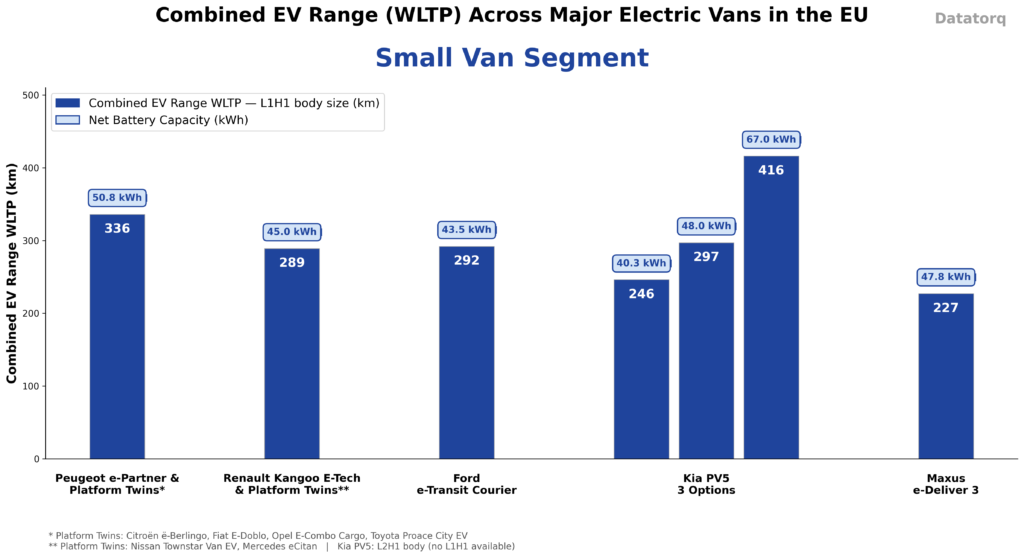
The Kia PV5’s three-tier lineup is the most interesting structural story here. Going from 40.3 kWh to 67.0 kWh lifts range from 246 km to 416 km — a roughly proportional gain (about 6.1 km/kWh at the small trim, 6.2 at the large), so the upgrade is buying capacity rather than a more efficient drivetrain. The Maxus e-Deliver 3, meanwhile, posts the lowest range in the segment (227 km) on a mid-pack 47.8 kWh battery, making it the least range-efficient model in this group.
Combined EV Range Across Medium Vans
The medium segment is where hidden specification quirks start to show. The Mercedes eVito’s higher trim adds 119 km of range — 383 km on 90 kWh vs 264 km on 60 kWh — but per-kWh efficiency actually edges slightly down (4.3 vs 4.4 km/kWh). The trim difference is paying for capacity, not efficiency, and speed-limiter variants can further inflate the headline figure in markets where the 80 km/h restriction applies.
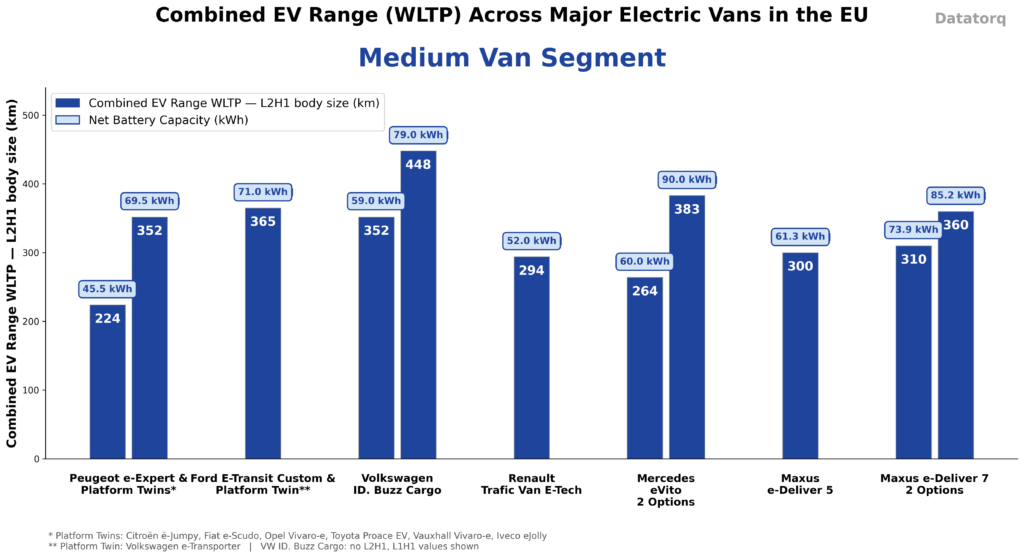
The Volkswagen ID. Buzz Cargo delivers the longest range in the segment at 448 km from 79.0 kWh — though, notably, this figure reflects the L1H1 body since no L2H1 Cargo version exists, so it isn’t directly comparable to the rest of the chart on a like-for-like basis. Among the genuinely L2H1 entries, the Peugeot e-Expert platform family’s upgrade from 45.5 kWh to 69.5 kWh lifts range from 224 km to 352 km, a healthy but proportionate gain. The Maxus e-Deliver 7’s two trims (310 km / 73.9 kWh and 360 km / 85.2 kWh) cluster around 4.2 km/kWh, but the smaller e-Deliver 5 (300 km / 61.3 kWh) is meaningfully more efficient at roughly 4.9 km/kWh — Maxus’s medium range carries the larger 7 at a noticeable per-kWh penalty. The Renault Trafic Van E-Tech, at 294 km from 52.0 kWh, is one of the most efficient L2H1 vans in the segment at roughly 5.7 km/kWh.
Combined EV Range Across Heavy Vans
The heavy segment is where battery scaling and range scaling diverge most sharply. The Mercedes eSprinter’s top trim posts the longest range in the segment at 452 km from 113.0 kWh, while the Renault Master E-Tech achieves 406 km from just 87.0 kWh — a noticeably better return per kWh than the eSprinter (4.7 vs 4.0 km/kWh), despite the smaller battery.
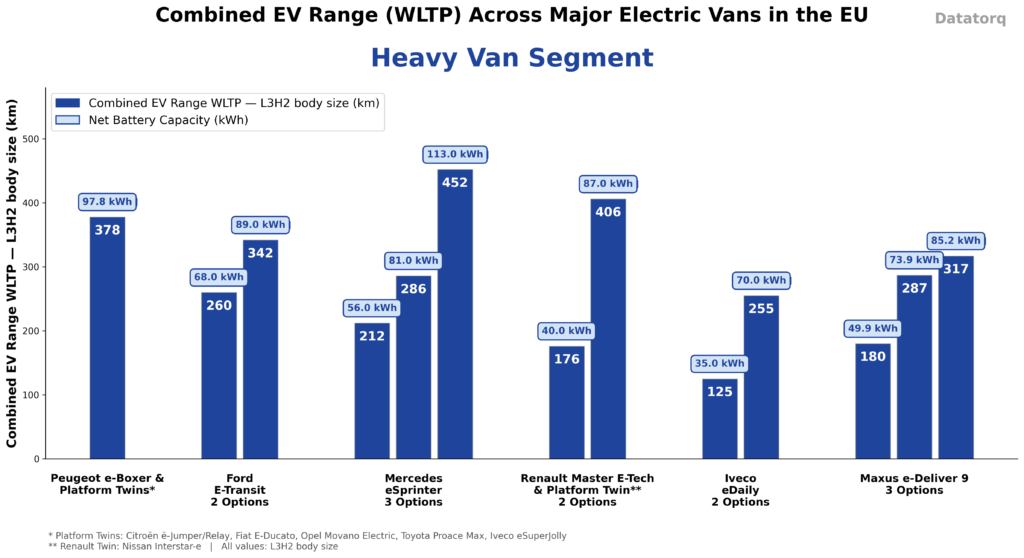
The Peugeot e-Boxer platform family delivers the second-longest range (378 km) from the largest single-option battery in the segment (97.8 kWh), covering a wide span of badge variants under one efficiency profile. The Iveco eDaily, restricted here to its two standard-van configurations, ranges from 125 km (35.0 kWh) to 255 km (70.0 kWh) — consistent, proportionate scaling, but the shortest range ceiling in the segment. The Maxus e-Deliver 9’s three trims (180, 287, and 317 km on 49.9, 73.9, and 85.2 kWh respectively) show diminishing returns at the top end: the jump from the second to third trim adds over 11 kWh for only 30 km of extra range, the weakest marginal efficiency of any upgrade step across all three segments.
Key Takeaways from the Data
- Range efficiency varies more than range itself. Two vans with similar WLTP figures can consume energy at very different rates depending on body type, weight, and platform architecture. Benchmarking on range alone misses this and it can be important for Total Cost of Ownership (TCO) calculations.
- Modularity is becoming a competitive differentiator. Kia PV5 in the small segment, Peugeot e-Expert, Mercedes eVito and Maxus e-Deliver 7 in the medium, Iveco eDaily and Maxus e-Deliver 9 in the heavy — manufacturers are increasingly offering battery tiers within a single model, allowing buyers to optimize for operational cycle rather than maximum specification.
- Published specs need normalization, not face-value comparison. Good benchmarking depends on comparable data — WLTP figures should be checked against factors that might impact battery efficiency and actual range (e.g. body configuration, trim, etc)
About the Data Behind This Analysis
The charts in this series draw on Datatorq’s standardized eLCV database, covering specifications and prices across 28+ markets. All range values are WLTP combined cycle. Body sizes are noted per segment (L1H1 for small, L2H1 for medium, L3H2 for heavy) to ensure like-for-like comparisons. The Volkswagen ID. Buzz Cargo is included in the medium chart as L1H1, since no L2H1 version exists.
Need transparent, standardised automotive data for your benchmarking tools or market intelligence reports? Contact our team to discuss how Datatorq can support your analysis.