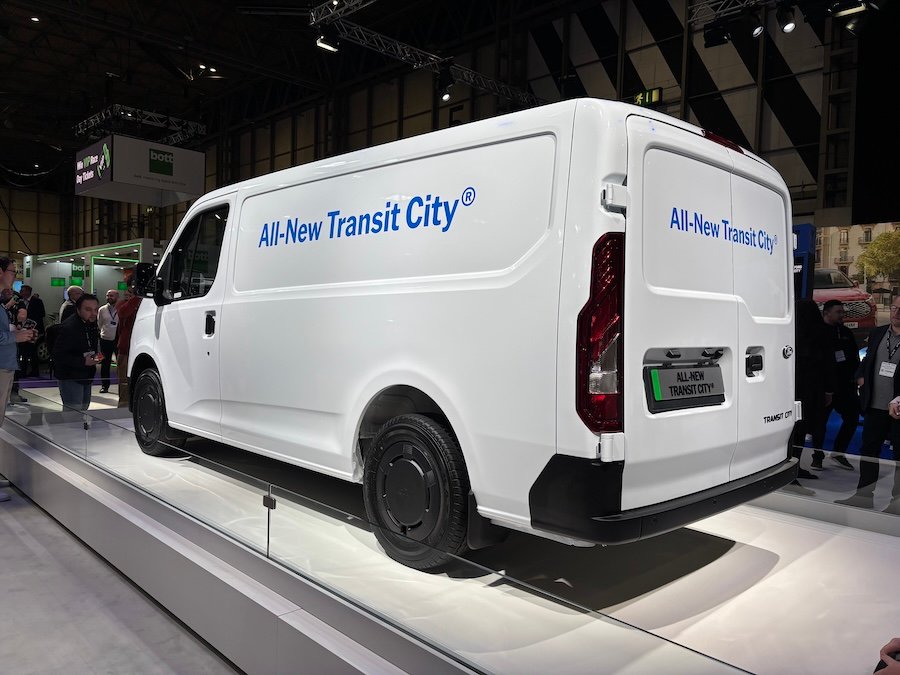
When Ford Pro launched the Transit City, most of the conversation focused on what it doesn’t do: it caps out at 254 km of WLTP range, it can’t tow, and it comes in a single trim with almost no options to speak of. Look at where it actually lands on the price lists, though, and a different story appears. Priced entry-to-entry against its electric medium van rivals across three European countries — Germany, the UK and Italy — the Transit City comes out as the cheapest configurable electric van in the segment in all three markets, and by a wide margin in two of them.
Ford Transit City specs: range, battery, charging and body options
The Transit City keeps things simple by design. One powertrain — 110 kW (150 PS) and 260 Nm, front-wheel drive — one 56 kWh battery (gross), and DC fast charging that peaks at 87 kW, enough for a 10–80% top-up in around 30 minutes. There’s a single trim (Trend) and a near-optionless specification, so the real choice is which of three bodies to take: a short-wheelbase low-roof van (L1H1), a longer high-roof van (L2H2), or a chassis cab — Ford’s first electric one-tonne chassis cab, which opens the door to converted bodies such as tippers and, from early 2027, refrigerated units on an electric PTO. Towing isn’t available on any version; Ford points operators who need it toward the existing e-Transit Custom instead.
Ford Transit City price vs electric van rivals in Germany, the UK and Italy
Line up the Transit City’s entry-level short-wheelbase van (L1H1) against its closest Medium Van EV rivals — same body class, cheapest configurable trim per model, prices excluding VAT in local currencies — and the pattern repeats in Germany, the UK and Italy: the Transit City is the cheapest van on the list every time. The comparison set is drawn from DataTorq’s harmonised Germany, Italy and UK price databases, which put every model’s entry version onto a common basis so the figures can be read side by side.
| Entry L1H1 excl. VAT | Germany (€) | UK (£) | Italy (€) |
|---|---|---|---|
| Ford Transit City | 35,990 | 29,000 | 31,950 |
| Toyota Proace Electric | 37,400 | 37,099 | 40,600 |
| Citroën e-Jumpy / e-Dispatch* | 38,300 | 41,210 | 37,400 |
| Maxus e-Deliver 5 | 38,990 | 35,088 | 39,800 |
| Maxus e-Deliver 7 | 45,990 | 46,435 | 46,500 |
| Volkswagen ID. Buzz Cargo | 40,645 | 35,650 | 51,990 |
| Ford e-Transit Custom | 48,700 | 43,630 | 43,850 |
| Volkswagen e-Transporter | 49,890 | 42,260 | 49,130 |
* Stellantis group entry price shown via the Citroën e-Jumpy in Germany and Italy and the e-Dispatch in the UK; the e-Vivaro, e-Expert and e-Scudo badge-twins price within the same band in each market.
The margin varies a lot by market. In Germany, the Transit City’s €35,990 undercuts the next-cheapest rival (Toyota Proace Electric, €37,400) by about 3.8% — a real but modest gap in a market where several rivals already price close together. In the UK, it undercuts the next-cheapest van (Maxus e-Deliver 5, £35,088) by 17.4%, and in Italy it undercuts the next-cheapest (Citroën e-Jumpy, €37,400) by 14.6%. Put differently: in the UK and Italy, the Transit City isn’t just the cheapest van in the segment — it’s priced in a different bracket from everything else on the list.
Ford Transit City L2H2 high-roof price vs Maxus e-Deliver 5
The more interesting point one body size up isn’t the size of the gap — it’s that the option exists at all. The high roof has quietly been disappearing from the Medium Van EV segment: Volkswagen and Renault used to offer an H2 body in their medium van line-ups and no longer do, leaving Maxus, with the e-Deliver 5 and e-Deliver 7, as the only competitor still offering one alongside the Transit City.
Where Maxus does compete, the Transit City is materially cheaper. Its L2H2 lists at £31,500 in the UK against £38,088 for the e-Deliver 5 L2H2 — 17.3% less — and at €34,200 in Italy against €42,200, a gap of 19.0%. For buyers who need the extra height, the practical choice in the segment is now Ford or Maxus.
Ford Transit City payload and cargo volume vs rivals
A price this far below the segment average usually comes with a catch somewhere in the spec sheet, and compared like for like it does. Measured on the same entry L1H1 versions the prices above are drawn from, the Transit City sits near the top of the field on cargo and at the bottom on payload. Its 6.0 m³ load bay is second only to the Maxus e-Deliver 5’s 6.6 m³, and ahead of the e-Transit Custom’s 5.8 m³ and the Toyota’s and Citroën’s 5.3 m³. Payload is where it gives most ground: 1,010 kg is the lowest maximum payload of any conventional van in the set, below the Citroën’s 1,288 kg, the Toyota’s 1,178 kg, the Maxus vans’ 1,125 kg and even the e-Transit Custom’s 1,012 kg. Read together, the entry Transit City buys a near-class-leading load bay and a modest carrying capacity — for a price 3.8–17.4% below the next-cheapest van in each of the three markets.
The figures below cover the entry L1H1 version of each model in Germany, Italy and the UK — the same versions the prices above are drawn from — with ranges shown as min–max where the figures differ across the three markets.
| Entry model L1H1 | Range (km) | DC (kW) | Payload (kg) | Cargo (m³) |
| Ford Transit City | 254 | 87 | 1,010 | 6.0 |
| Ford e-Transit Custom | 327–370 | 125 | 1,012 | 5.8 |
| Maxus e-Deliver 5 | 334–335 | 70 | 1,125 | 6.6 |
| Maxus e-Deliver 7 | 318 | 90 | 1,125 | 5.9 |
| Toyota Proace Electric | 212–224 | 100 | 1,092–1,178 | 5.3 |
| Citroën e-Jumpy / e-Dispatch | 226–346 | 100 | 926–1,288 | 5.3 |
| Volkswagen e-Transporter | 322–371 | 125 | 1,013–1,029 | 5.8 |
| Volkswagen ID. Buzz Cargo | 322–448 | 165–185 | 631–745 | 3.9 |
Source: DataTorq Medium Van EV databases — DE, IT, UK (August 2026). One entry-level L1H1 version per model per market; range, DC charge rate and payload shown min–max across the three markets; payload is maximum without driver; cargo volume is the standard body figure.
Ford Transit City drawbacks: range, payload, towing and options
Range: 254 km WLTP combined, the same figure in all three markets, is second-lowest in the set — ahead of only the Toyota Proace Electric (212–224 km), and well behind the e-Transit Custom (327–370 km) and the Maxus e-Deliver 5’s 334–335 km.
Payload: 1,010 kg is the lowest maximum payload of any conventional van here — the Citroën e-Jumpy / e-Dispatch carries up to 1,288 kg and both Maxus vans — the e-Deliver 5 and e-Deliver 7 — 1,125 kg.
Towing: not available on any version. Rivals in this comparison generally do offer it.
Choice: one trim, one powertrain, one battery size. There’s no bigger-battery upgrade path and next to no options list — the low entry price is also close to the only price.
Charging speed: 87 kW DC is second-lowest in the set — ahead of only the Maxus e-Deliver 5’s 70 kW, and well short of the e-Transit Custom and e-Transporter’s 125 kW peaks, let alone the ID. Buzz Cargo’s 165–185 kW.
Where the Ford Transit City is available to order in 2026
All three markets in this comparison are live. As of August 2026, the Transit City is launched and configurable in Germany, the UK and Italy, alongside Spain, the Netherlands and Belgium. France currently has a press release but no configurable order book yet, and Poland is listed as an upcoming model only — so the pricing picture in those two markets isn’t established yet.
Ford Transit City FAQ
In Germany, the UK and Italy, yes — it has the lowest entry price of any Medium Van EV in this comparison set in all three markets as of August 2026 on the short-wheelbase van, and in the UK and Italy on the long, high-roof van.
It varies by market: about 3.8% cheaper than the next-cheapest rival in Germany, 17.4% cheaper in the UK, and 14.6% cheaper in Italy (entry L1H1 van, excl. VAT).
No — the load bay is one of the largest in the set. On the entry L1H1 body it carries 6.00 m³ — behind only the Maxus e-Deliver 5’s 6.60 m³, and ahead of the Toyota Proace Electric and Citroën e-Jumpy / e-Dispatch at 5.3 m³ — with 1,010 kg of payload, the lowest maximum payload of any conventional van in the comparison set. The trade-offs show up in payload, range, charging speed, towing capability and options rather than in load volume.
Not yet. It’s configurable in Germany, Spain, the UK, the Netherlands, Belgium and Italy as of August 2026. France has a press release only, and Poland is listed as an upcoming model.